I do not like spreading negativity out there, but I needed to warn people about this device. I bought this for 80 dollars on ebay; I'm not gonna link from whom, because he or she does not deserve more sales of this awful device. When it works, it works, albeit with flaws. The image produced is sharp, as a component-video signal should be, and the colors are accurate, except that there is a green tint to the entire picture. I've read that one has to open these things up and adjust the 'pots' inside (an electrical term) with a screwdriver. I never really tried doing that or minded the green tint too much, because it's very subtle. What I did mind a lot, was the fact that sometimes, it won't work, and I'll only get audio. This is a big problem. I wouldn't mind the colors being a little off, or there being some 'noise' in the video-signal, but when the success-rate of the thing actually working is 50%, it's a deal-breaker. I paid 80 dolla...
As a recently new Sega Saturn owner, I knew I had to get the Sega Saturn 3D Control Pad because it was the definitive controller for playing Nights Into Dreams. I decided to purchase the more aesthetically-pleasing Japanese version. Upon first inspection, it is noticeably big - bigger than it should be. Sega was probably going for form over function here, because the round shape does look like a mini-spaceship or UFO, which goes with their theme of space with the Saturn itself, but it is not the most ergonomically comfortable controller out there. For example, when playing six-button fighting-games, it is difficult to hold the controller in the left hand and 'piano' the buttons with the right. The d-pad is a little different from the American Model 1 and Japanese Model 2 controllers'. It feels a little stiffer. Of the three controllers I have tried, it has my least favorite d-pad. On the plus-side, however, it features the best start-button of the three. ...
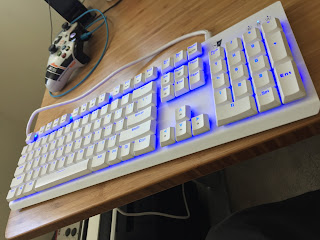
This 'review' will be covering the White variant with Agile Blue Mechanical Switches, and I won't be going into technical depth, just how I personally feel about this. When I first opened the box that contained the actual OEM-box for the keyboard itself, my heart dropped because on the box was a picture of a black keyboard. Fortunately, I could breathe a sigh of relief when I opened it to find the white keyboard I had purchased. One of the first things I noticed was how heavy the keyboard was. This is by far the heaviest keyboard I have ever owned, and that's a good thing. It probably means it's high-quality. Another thing that delighted me was the USB-cable. It is the best braided cable I have ever laid my hands on. It's thick, soft, light, and bends fairly easily. The Tesoro Gram Spectrum (TSG) is my first foray into mechanical keyboards, if you don't include the old keyboards from the '90s, and I love it. I picked it because...